REVIEW · HONOLULU
Complete Pearl Harbor Experience Departing from Maui
Book on Viator →Operated by Hawaii Island Experiences, LLC · Bookable on Viator
Morning history, with a weight you can feel. This Complete Pearl Harbor Experience stacks the big names in one efficient day, from the Visitor Center to USS Arizona, plus submarines, battleships, and then Honolulu’s royal and historic sites. It’s also built around convenience: round-trip interisland flights and airport pickup are included, so you’re not wrestling with schedules on your own.
I especially like the way it moves you through Pearl Harbor with the right pacing: first the 23-minute orientation film and exhibits, then the quiet boat ride, and finally time at the USS Arizona Memorial to actually take it in. I also like the variety after Arizona—USS Bowfin’s submarine museum, the USS Missouri deck tour, the USS Oklahoma memorial area, and the Pearl Harbor Aviation Museum—so the day isn’t just one heavy stop.
One drawback to keep in mind: timing can be tight. With a return flight later in the day, you’ll want a realistic expectation that you may not linger at every location as long as you’d like, and you should plan your day around the tour’s schedule first.
In This Review
- Key takeaways before you go
- Why This Pearl Harbor Day Trip Works From Maui
- Price and value: what you’re really paying for
- First step: your 7:00 am pickup and airport routine
- Stop 1: Pearl Harbor Historic Sites Visitor Center
- Stop 2: USS Arizona Memorial and the meaning behind the details
- Stop 3: USS Bowfin Submarine Museum & Park
- Stop 4: USS Missouri Memorial (Mighty Mo) and a no-host lunch pause
- Stop 5: USS Oklahoma Memorial and the marble stick detail
- Stop 6: Pearl Harbor Aviation Museum (no simulator included)
- Stop 7: Downtown Honolulu with narration
- Stop 8: Punchbowl (National Memorial Cemetery of the Pacific) views
- Stop 9: Iolani Palace and the last chapter of Hawaii’s monarchy
- Kawaiahaʻo Church: the Westminster Abbey of the Pacific angle
- The guide factor: when narration is the difference
- What to pack and how to plan your day
- Who this tour fits best (and who should choose another plan)
- Should you book this Complete Pearl Harbor Experience?
- FAQ
- What time does the tour start?
- Does the price include flights between Maui and Honolulu?
- Are airport transfers included in Honolulu?
- Are admission tickets to Pearl Harbor attractions included?
- What attractions are included besides USS Arizona Memorial?
- Is the Pearl Harbor Aviation Museum flight simulator included?
- Can I bring a regular purse or bag into Pearl Harbor?
- Is lunch included?
- Is respectful silence expected at USS Arizona Memorial?
- How long is the tour?
Key takeaways before you go
- Maui-to-Oahu flights included: Kahului to Honolulu (HNL) and back, handled for you.
- USS Arizona Memorial is the emotional centerpiece: reflection-focused visit rules, including silence encouragement.
- You’ll see more than Arizona: USS Bowfin, USS Missouri, USS Oklahoma, plus the Aviation Museum.
- Bag rules at Pearl Harbor are strict: no purses/bags allowed inside; storage is available for a fee.
- Small group size (max 40) helps you get attention when questions come up.
- Downtown Honolulu has real narration: you get a guided story arc at the historical sites beyond Pearl Harbor.
Why This Pearl Harbor Day Trip Works From Maui
If you’re starting in Maui, the biggest win is simple: you don’t have to build the whole day yourself. This tour bundles the interisland flight, Honolulu airport transportation, and entry tickets so you can spend your energy on the sites—not on logistics.
The second thing that makes it practical is the sequence. You start at Pearl Harbor with context first, not last. At the Visitor Center, you get exhibits leading into the attack on December 7, 1941, followed by the 23-minute documentary. That order matters. It helps your brain organize what you’re about to see at USS Arizona, where the focus is intentionally solemn.
Finally, the tour goes beyond history-on-a-single-spot. After USS Arizona, you keep moving: submarine, battleship, aviation, and then Honolulu’s royal and historic landmarks. For many first-timers, that’s a great trade: one day with the highlights, without losing your whole trip to just one museum district.
You can also read our reviews of more tours and experiences in Honolulu.



Price and value: what you’re really paying for
At $499.99 per person, this isn’t a budget tour. But it also isn’t just an admission-ticket bundle. The value comes from three big pieces you’d otherwise have to solve separately:
- Round-trip flights between Maui and Honolulu
- Round-trip ground transportation in Honolulu
- Admission tickets to multiple Pearl Harbor attractions
When you price those separately (especially interisland flights on limited schedules), the tour starts to make more sense. You’re paying for time, reduced stress, and fewer moving parts. That matters if you’re only in Hawaii for a short stretch or you don’t want to gamble on last-minute transportation.
The trade-off is that you’re still on a fixed schedule. A higher price usually buys smoother coordination, but it doesn’t guarantee you’ll be able to linger at each site longer than the plan allows.
First step: your 7:00 am pickup and airport routine
The day starts early. The scheduled start time is 7:00 am, and pickup depends on which airline you used to arrive in Honolulu:
- Southwest Airlines: pickup at Terminal 2, baggage claim 31, area 5
- Hawaiian Airlines: pickup at Terminal 1, area 1
This part is worth taking seriously. If you show up late at the pickup point, you can lose time that’s supposed to protect your Pearl Harbor experience and your flight connections.
Also, remember the “what’s included” detail: transportation runs from the Honolulu airport (HNL) to the tour sites and back. Transportation to Kahului Airport on Maui is not included, so you’ll want your own plan for getting to your departure.
Stop 1: Pearl Harbor Historic Sites Visitor Center
This is where the tour earns its right to be first. At the Pearl Harbor Historic Sites Visitor Center, you get exhibits that set up the events leading to the attack on December 7, 1941. Then comes the 23-minute documentary film, a clean primer before you head out onto the water.
After the exhibits and film, you board a U.S. Navy-operated boat for a short crossing to USS Arizona Memorial. The ride is only about 10 minutes, and it’s described as calm with views of surrounding military installations. That short transition is more than scenic filler. It gives you a moment to shift from “museum mode” into “memorial mode.”
Practical note: admission tickets are included, and your guide provides them the day of the tour. That saves you time at check-in and keeps you from scrambling for printed confirmations.
What to watch for: the Visitor Center area can feel busy. Your best move is to keep your eyes open for signage and be ready for a quick move to the boat when the group is called.
Stop 2: USS Arizona Memorial and the meaning behind the details
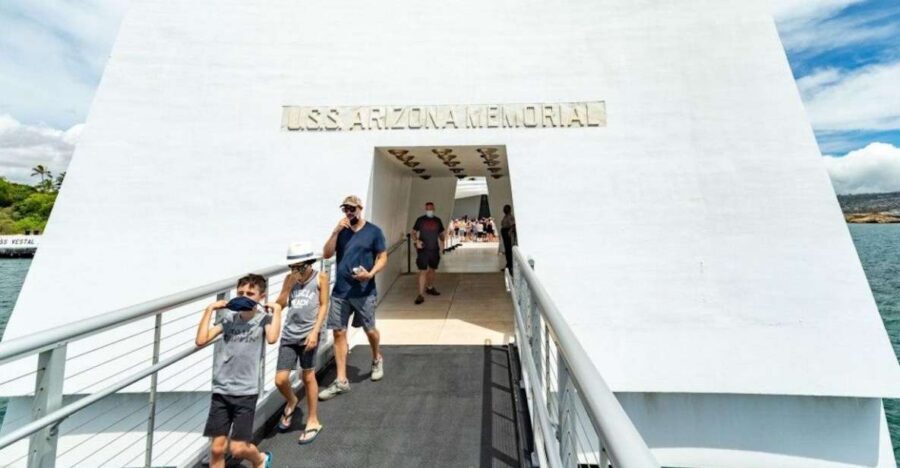
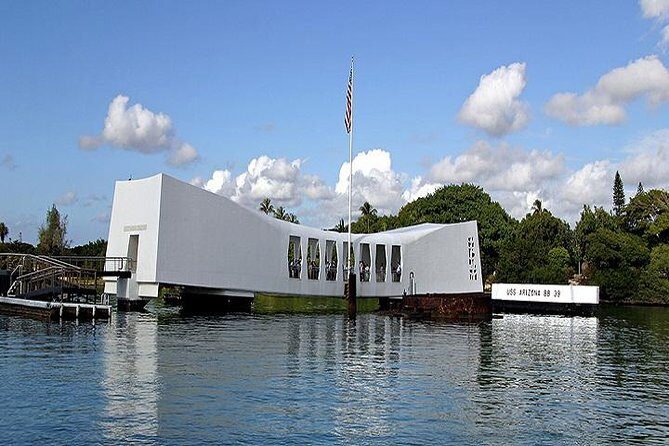
USS Arizona Memorial is the emotional centerpiece: a white, open-air structure spanning the remains of the sunken battleship. It’s intentionally quiet and designed for reflection, not sightseeing.
Inside, you can look down into the water. You’ll see parts of the wreckage, with the ship’s outline visible just below the surface. Oil droplets are often referred to as The Tears of the Arizona, and that small phrase shows up for a reason: it turns the physics of what you’re seeing into something human to remember.
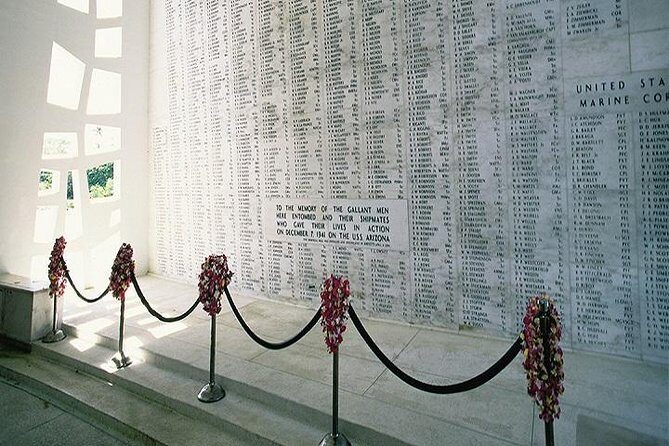
At the far end is the Remembrance Wall, inscribed with the names of 1,177 crew members who lost their lives aboard USS Arizona. This is where many people stop walking and just stand. It’s also where the experience stops being informative and becomes personal.
Important courtesy note: you’ll be encouraged to keep respectful silence during your visit. That’s not a rule for enforcement so much as part of how the memorial keeps its dignity.
One consideration: this area is popular. Expect crowds. The time you have here is part of why the tour starts early, and it’s also why you should avoid planning anything “right after” in your head that would make you rush through.





Stop 3: USS Bowfin Submarine Museum & Park
After the weight of USS Arizona, USS Bowfin gives you a different angle on history: undersea warfare and the human engineering behind it. You get admission to the USS Bowfin Submarine Museum & Park, plus a headphone set for narration onboard the submarine.
That headphone narration is a smart format for this type of site. It lets you move at your own pace while still getting context, and it avoids the stop-and-start problem that can happen with groups in tight spaces.
The museum is also a nice contrast to the memorial spaces because it’s structured for learning. You’ll come away with a more complete picture of the day’s naval environment: not only what happened, but what different parts of the war looked like.
What to watch for: submarine spaces can feel warmer and closer than you expect. Comfortable shoes matter because you’ll be walking through museum areas and around the park.
Stop 4: USS Missouri Memorial (Mighty Mo) and a no-host lunch pause
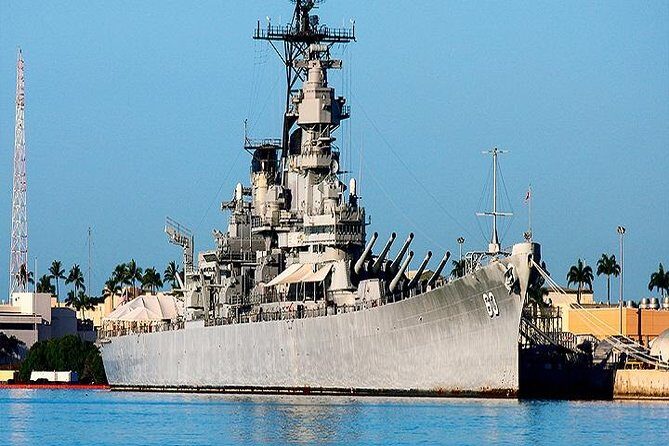
Next up is Ford Island and the Battleship Missouri Memorial, often called the Mighty Mo. You’ll have USS Missouri deck tour time as part of the stop, along with the transportation on Ford Island.
This is a shift again: USS Missouri feels more like “stand inside the machinery of history.” It also gives your day a sense of momentum. Instead of only memorial viewing, you get a guided-style physical experience, where you can look out from a real deck and understand scale.
There’s also a no-host lunch stop at Laniakea Cafe. No-host means you pay for your own meal, and it’s the easiest place to grab something quickly without derailing the rest of the schedule.
Small strategy tip: if you have dietary needs, decide what you’ll do before lunch day starts. With a fixed itinerary, it’s not the moment to experiment.
Stop 5: USS Oklahoma Memorial and the marble stick detail
USS Oklahoma Memorial is adjacent to the Missouri area. The experience here is very specific and very focused: you’ll witness 429 marble sticks, marking where soldiers lost their lives.
Those marble sticks work like a quiet ledger. Instead of big speeches, you get a visible count of people and a stark reminder that this was not abstract tragedy.
Timing for this stop is short (about 15 minutes), so you’ll want to use that time deliberately. Look first, then read. Even brief visits feel more meaningful when you don’t rush to the next stop instantly.
Stop 6: Pearl Harbor Aviation Museum (no simulator included)
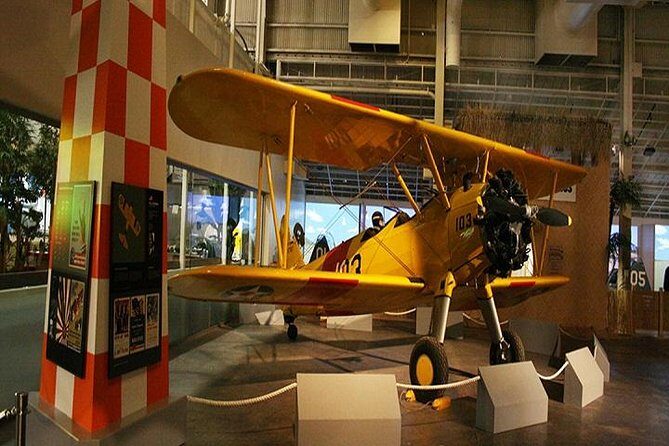
Then you shift into aviation at the Pearl Harbor Aviation Museum. Admission is included for about 1.5 hours.
One key detail: this included admission does not include the flight simulator. If aviation simulators are on your wish list, plan on budgeting separately (or adjusting expectations) because it’s not bundled in what this tour pays for.
This museum is a solid follow-up after the Navy-heavy stops. It rounds out the day by showing how air power and aircraft operations fit into the broader attack and its aftermath.
Stop 7: Downtown Honolulu with narration
After Pearl Harbor, you’ll spend time on historic downtown Honolulu for about 45 minutes, with narration from a local guide.
This portion is where the tour feels more like a classic city tour. The content is described as a mix of Hawaii’s history, cultural heritage, and modern city life. It’s also where your guide’s storytelling skills can connect dots between royal history, government spaces, and the way Honolulu evolved.
This is also a good mental reset. The memorials stay heavy, and downtown helps you transition back to the living city.
Stop 8: Punchbowl (National Memorial Cemetery of the Pacific) views
The National Memorial Cemetery of the Pacific sits on top of extinct volcano, commonly called Punchbowl. It’s the final resting place for thousands of U.S. military members.
What you’ll remember most here are the setting and the sightlines. The grounds are beautifully maintained, with rows of white headstones against lush greenery. And because Punchbowl crater sits high, you get stunning views over Honolulu—downtown, Diamond Head, and the coastline.
This stop works especially well after the war memorials. It doesn’t rehash the attack. Instead, it reinforces the long arc of remembrance.
Stop 9: Iolani Palace and the last chapter of Hawaii’s monarchy
Then comes Iolani Palace, described as the only royal palace in the United States. This is where you learn Hawaii’s monarchy not as a trivia topic, but as a real political world—stories tied to King Kalākaua and Queen Liliʻuokalani, the last reigning monarchs.
Time at the palace is short (around 15 minutes), so I’d treat this as a “get your bearings fast” stop. You’re not expected to memorize every room. You’re expected to walk away with context you can build on if you return.
From the palace area, you’ll also view the King Kamehameha Statue and the historic building called Aliʻiōlani Hale, which now houses the Hawaii State Supreme Court. The guide’s talk includes “talk story” around the original government building of the Hawaiian Kingdom.
Kawaiahaʻo Church: the Westminster Abbey of the Pacific angle
The tour includes time to learn about Kawaiahaʻo Church, often referred to as the Westminster Abbey of the Pacific. Your guide explains the church’s significance and its role in Hawaii’s religious history.
This stop adds texture. After learning about the monarchy at Iolani, you see another piece of the kingdom’s evolving cultural story—how religion and power shifted over time.
Even if you only get a brief stop, Kawaiahaʻo helps the day feel like more than war history. It becomes Hawaii history, too.
The guide factor: when narration is the difference
One thing that really sticks in the overall experience is the quality of the guide when the storytelling is part of the plan. A standout example: guide Ariel is noted for unsurpassed knowledge and for keeping the delivery lively.
That matters because a day like this can turn into “locations, photos, move on.” When a guide can connect the dots—between what you saw at USS Arizona and what you see later around Honolulu—it turns a list of stops into a coherent day.
Even if you’re not perfect with details, good narration gives you a way to remember what you experienced.
What to pack and how to plan your day
Pearl Harbor has strict rules, and they’re not subtle.
- No purses and bags inside the Pearl Harbor area. You can store bags for $7.00 each
- Clear plastic bags are allowed as long as the contents are visible (think football-game style)
- Bags with medical equipment may be allowed if appropriate
- Wear comfortable shoes. You’ll walk a lot
- No smoking on visitor center grounds or at the memorial
- No swimwear
Also, meals are on your own. Lunch is available as a no-host option at the scheduled cafe, and there are on-site dining options near Pearl Harbor and around the Missouri area if you need a snack.
My practical advice: travel light. If you can carry what you need in an allowed clear bag, you’ll waste less time and feel less stressed when security rules kick in.
Who this tour fits best (and who should choose another plan)
This is a strong fit if you:
- Want a one-day solution from Maui that includes flights
- Care about seeing multiple Pearl Harbor sites, not just the headline stop
- Like guided context during portions of the day (especially downtown Honolulu and the city history)
It may not be ideal if you:
- Need lots of free time to wander at Pearl Harbor at your own pace
- Are sensitive to schedule pressure near interisland flight times
- Prefer a fully guided, step-by-step tour inside every attraction (this tour emphasizes time at the sites plus narration where noted, rather than constant guiding everywhere)
If you’re mobility limited, note that the tour isn’t recommended for people who cannot walk about 4 city blocks. That’s a real factor because you’ll be moving between memorials, museums, and Honolulu stops.
Should you book this Complete Pearl Harbor Experience?
I’d book it if your priority is maximum major-site coverage with minimal logistics. Including interisland flights and admission tickets is a big deal, and the day’s sequence gives you context early and reflection time where it matters.
I’d think twice if you’re the type who needs long, unstructured time at USS Arizona Memorial or if you’re flying very tight on the back end. The memorials are popular and the schedule has to protect your flight return, so plan your expectations around that rhythm.
If you want to turn one day into a meaningful, packed, and well-organized overview of Pearl Harbor plus Honolulu history, this tour is a solid choice—especially when you bring the right attitude: slow down where the site asks you to, and let the guide’s storytelling do the heavy lifting where you’re moving between stops.
FAQ
What time does the tour start?
The start time is 7:00 am.
Does the price include flights between Maui and Honolulu?
Yes. Round-trip inter-island airfare from Kahului Airport to Honolulu Airport (HNL) is included.
Are airport transfers included in Honolulu?
Yes. Roundtrip ground transportation from Honolulu International Airport (HNL) is included.
Are admission tickets to Pearl Harbor attractions included?
Yes. Entry tickets to all the attractions on the tour are included, and your guide will provide them on the morning of the tour.
What attractions are included besides USS Arizona Memorial?
The tour includes USS Bowfin Submarine Museum & Park, Battleship Missouri Memorial (deck tour), USS Oklahoma Memorial, Pearl Harbor Aviation Museum, and additional Honolulu sites such as Punchbowl and Iolani Palace.
Is the Pearl Harbor Aviation Museum flight simulator included?
No. The simulator is not included.
Can I bring a regular purse or bag into Pearl Harbor?
No. Purses and bags are not allowed inside Pearl Harbor. Bags can be stored for $7.00 each, and clear plastic bags are allowed.
Is lunch included?
Lunch is not included. There is a no-host lunch stop at Laniakea Cafe, and meals are at your own expense.
Is respectful silence expected at USS Arizona Memorial?
Yes. Visitors are encouraged to maintain respectful silence while on the USS Arizona Memorial.
How long is the tour?
It runs about 9 to 11 hours, depending on conditions and the day’s timing.