REVIEW · OAHU
Private Group Surf Lesson for 4 by Waikiki Beachboys at the Royal
Book on Viator →Operated by Waikiki Beach Services · Bookable on Viator
Surfing starts right in Waikiki. This private, 1-hour lesson in the Royal Hawaiian area mixes on-the-water coaching with basic surf theory and history, so you’re not just guessing what to do every time you paddle out. You’ll be working in a tight group, which means more chances for the instructor to correct your mechanics on the spot.
What I like most is the focus on the core skills: paddling, standing up, and balance. The surfboard is included too, and the lesson is built around practical mechanics rather than vague advice. When the instructor is patient (and many are), it feels like you’re getting real feedback fast, not just being sent into the waves.
One caution: the lesson assumes you can swim, and a smooth, beginner-friendly experience depends on the instructor’s teaching style. If you’re very new, go in ready to do some instruction quickly on land and then learn through reps in the water.
In This Review
- Key things to know before you book
- Waikiki basics: what that birthplace setting really means
- Where you start at Royal Hawaiian and how to be ready
- In-water coaching: paddling, standing, and balance for real beginners
- Surf theory and history: why it helps your body, not just your head
- Gear, what to bring, and what costs extra
- Who this surf lesson fits best (and who should be cautious)
- Price and value: is $100.76 per person worth it?
- How to make your lesson go well in the first 60 minutes
- Should you book this Waikiki Beachboys surf lesson at the Royal?
- FAQ
- How long is the private surf lesson?
- Do I need to be able to swim?
- What age is required?
- Is a surfboard included?
- What should I bring?
- What’s the cancellation cutoff for a full refund?
Key things to know before you book
- Waikiki “birthplace” location: surf lessons here feel historic, even when you’re just trying to stand once
- Small private group (4 to 5 max): more personal attention than typical big classes
- 1 hour is the whole window: plan to move, listen, and practice without expecting a slow pace
- You get surfboard included: no extra gear rental cost to figure out
- Theory plus technique: you’ll learn enough background to understand what your body is doing
- Swim ability is required: if you’re not comfortable in the water, this will be stressful
Waikiki basics: what that birthplace setting really means
Taking a surf lesson in Waikiki has a special feel because this is the place people point to when they talk about the early roots of surfing in Hawaii. For you, that matters less because you’ll be wandering around museums and more because the ocean setup, the vibe, and the shoreline layout make learning feel immediate. You’re right where surf culture lives year-round, even on days when you’re focused on tiny steps like paddle form and board control.
The lesson itself is also built around essentials, not tricks. Expect coaching that targets what usually stops brand-new surfers: getting out past the breaking area, paddling with purpose, popping up with balance, and staying steady through the short rides you’ll likely catch. The time is tight, so the instructor’s job is to help you produce movement patterns you can repeat.
You also get surf mechanics and theory, plus history. That can sound like extra talk, but it tends to be useful when it translates into what to do with your arms, hips, and weight distribution. When it clicks, it turns random tries into progress you can feel in a single session.
My advice: treat the history/lesson talk as part of the training. If the instructor explains why something matters, you’ll remember it better when you’re trying to stand before the next wave slips by.
You can also read our reviews of more private tours in Oahu

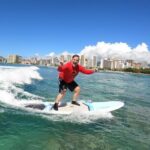
Where you start at Royal Hawaiian and how to be ready
Your meeting point is Waikiki Beach Services at the Royal Hawaiian, 2259 Kalākaua Ave, Honolulu, HI 96815. The activity ends back at the same meeting spot, so you’re not dealing with a long route or multiple stops.
Before you get there, do the simple prep that helps you spend more of that 1 hour practicing. Bring your own towel, sunscreen, and rash guard. The lesson includes a surfboard, but it does not include towels or sunscreen, and rash guards can make your first experience more comfortable—especially when you’re doing lots of paddling and board contact.
Also, mentally gear up for the “fast feedback” format. Even when instruction on land is brief, you’ll still be able to ask questions. If you’re nervous, this is also the moment to say what you’re worried about: standing up, fear of falling, or not knowing how to time paddle strokes.
And one more non-negotiable: you must be able to swim. That requirement isn’t there to be picky. It affects how the instructor manages you in the water and how confident you’ll feel when you wipe out.
In-water coaching: paddling, standing, and balance for real beginners
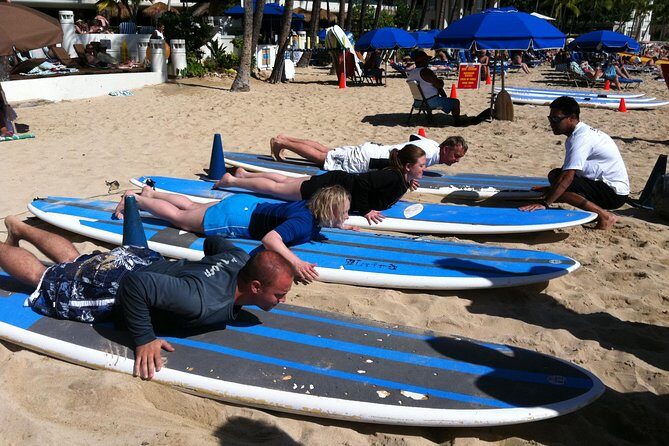
The heart of the lesson is straightforward: learn the basics of how to paddle, stand up, and balance on the board. In a small-group setup, the instructor can watch what you’re doing and adjust quickly, like changing your paddle rhythm or timing your pop-up to match wave push.
Here’s what that usually looks like in practice for a new surfer:
- You start by focusing on paddling mechanics so you can position yourself instead of flailing.
- Then you work on the stand-up movement, typically repeating the sequence until your body stops panicking.
- Finally, balance becomes the main challenge, because even if your feet land, staying stable on a moving board is the whole game.
You’re also working within a private group structure with 4 to 5 people max. That size is a big deal. In larger classes, instructors spend too much time managing spacing and not enough time correcting you. With fewer people, you’re more likely to get direct cues tailored to your attempt.
That said, here’s the consideration from past lesson experiences: instructor teaching style can swing the vibe from encouraging to stern. Some sessions feel patient and paced, with clear guidance. Other experiences can feel more directive, with less explanation on land and less guidance once you’re out. The best thing you can do is show up ready to work, and use your voice early: ask for a simple cue you can follow in the water.
Practical move: if you’re totally new, ask the instructor to give you one key focus for the day, like paddle timing or keeping your weight forward. One focus is easier than five.
Surf theory and history: why it helps your body, not just your head
This is not just a board-and-waves workout. You’ll get surfing theory and history mixed into the session. For many first-timers, that seems like extra. But I like it when it’s used as a translation layer between what you feel and what you’re actually doing.
Theory and mechanics can connect dots like:
- why paddle technique matters for catching the right push
- how your stance affects stability
- what to expect from wave behavior when you’re on a beginner board
- how the sport developed in Hawaii and why the culture matters
Even if the history portion is short, it can help you understand why instructors emphasize basics so hard. Surfing looks free and stylish, but it’s built on repeatable fundamentals. If you learn what the fundamentals are trying to accomplish, you’re less likely to blame yourself when a wave doesn’t cooperate.
And yes, the instruction also helps you avoid common beginner errors. For example, when people don’t understand what’s happening, they paddle too hard in the wrong moment or they stand with weight in the wrong place. Mechanics talk gives you a better chance to correct the pattern before you get stuck repeating the same mistake for the whole session.
If you want the most value from this part, listen for the “why” behind the cue. Then apply that idea immediately when you’re back on the board.
Gear, what to bring, and what costs extra
This lesson includes a surfboard and a professional guide, with all taxes, fees, and handling charges included. There’s also an ocean stewardship fee of $1 USD effective 01/01/2024, which is listed as not included.
What is not included:
- souvenir photos and video (available to purchase)
- transportation to or from the attraction
- towels
- sunscreen
So your personal checklist is simple:
- Towel
- Sunscreen
- Rash guard
- Swim-capable confidence (because you must be able to swim)
The “bring your own rash guard” detail matters more than people think. With lots of paddling, you’ll get friction and board contact. A rash guard helps you stay comfortable enough to actually keep practicing instead of constantly adjusting your focus.
On the bonus side, there’s an option to buy photos and video afterward. If you’re like me and enjoy looking back at proof you actually did it, plan for that cost if it matters to you.
You can also read our reviews of more tours and experiences in Oahu



Who this surf lesson fits best (and who should be cautious)
This lesson has clear boundaries:
- You must be over 13 years old
- You must be able to swim
- For group lessons, the group is 13 and older
- The small group is designed around 4 students minimum and up to 5
It’s also described as private, meaning your group is the only group participating. That matters because you’ll learn at your group pace instead of being rushed by a crowd.
For many people, this setup is ideal if you want personal attention without paying for a full private 1-on-1 session. If your goal is to get a foundation quickly—paddling technique, standing mechanics, balance—this is a smart way to spend your time in Waikiki.
But the one caution is beginner patience. Some past lessons have worked beautifully, with instructors taking time and being calm with corrections. Other experiences have felt like less instruction on land and more sternness in the water. If you’re brand-new and you know you need encouragement and extra time for the first attempts, message or ask before you commit about expectations for beginners. You’re not asking for special treatment—you’re asking for clarity on how instruction will be handled during that first hour.
Best fit: people who can swim, are 13+, and want a focused 1-hour surf lesson with board provided.
Consider twice: if you’re not comfortable in open water or if you panic easily when you feel rushed.
Price and value: is $100.76 per person worth it?
At $100.76 per person for about 1 hour, the value really comes down to what’s included and how much coaching you get. In your case, that price covers:
- a professional guide
- a surfboard
- all taxes, fees, and handling charges
Then there’s that additional $1 ocean stewardship fee listed as not included, which is minor but worth knowing so you aren’t surprised.
So what are you really buying? Not just waves. You’re buying time with a guide who teaches the fundamentals (paddle, stand, balance) and provides in-water feedback within a tight group. For Waikiki, that location factor matters because you’re learning in the center of surf culture rather than somewhere harder to access.
If you compare this to doing a rental and trying on your own, the difference is huge. Surfboards are only half the equation; the other half is coaching your body through the basics so you actually stand and catch real attempts during the limited session window.
My rule of thumb: if you’re serious about learning fundamentals this trip, a coached lesson is usually the better spend than guesswork. The only “value risk” is instructor fit—some people get calm, patient guidance, while others have experienced more stern direction. Still, the small group size helps you get attention even when the delivery style is more direct.
How to make your lesson go well in the first 60 minutes
You can’t control the waves, but you can control your readiness and your questions. Here are the practical moves that help most in a short surf lesson.
1) Arrive with your gear ready
Pack your towel, sunscreen, and rash guard so you’re not scrambling right before you go out.
2) Tell the instructor what you need
If you’re afraid of falling, say so. If you’re unsure about standing timing, ask for one cue you can repeat. This helps the guide tailor corrections to your mindset.
3) Practice the sequence, not just the outcome
Trying to stand is the goal, but the real skill is the steps that lead to standing. Focus on what you do right before you pop up—then repeat.
4) Treat every wipeout as data
Wipeouts are normal. If you keep doing the same thing, you’ll keep repeating the same result. Ask what to change, even if it’s a tiny adjustment like hand position or where your weight goes.
5) Use the small-group advantage
With only 4 to 5 people, you’re not one of many. If the instructor walks by, catch them for a quick question. In a bigger class, you’d lose that chance.
And if you’re the type who gets nervous: you’re not alone. Plenty of first-timers start scared and then walk away thinking, that was fun and I can do this. You just need a plan for the first attempts.
Should you book this Waikiki Beachboys surf lesson at the Royal?
If you’re 13+, can swim, and want a guided start in Waikiki without overcomplicating your day, I’d book it. The combination of surfboard included, small-group attention, and an hour-long focus on paddling, standing, and balance is a solid recipe for making real progress during a single session.
The main reason you might hesitate is beginner expectations. Some sessions sound patient and supportive, while others have felt more stern or less instruction-heavy once in the water. If you know you need extra hand-holding in your first lesson, go in ready to ask for clear cues early and keep your focus on one or two mechanics at a time.
If you want Waikiki vibes plus fundamentals taught in a tight, coached format, this is a smart way to spend your time.
FAQ
How long is the private surf lesson?
It runs for about 1 hour.
Do I need to be able to swim?
Yes. Participants must be able to swim.
What age is required?
You must be over 13 years old. For 12 and younger, the data indicates private one-on-one individual lessons are required.
Is a surfboard included?
Yes. A surfboard is included.
What should I bring?
Bring your own towel, sunscreen, and rash guard.
What’s the cancellation cutoff for a full refund?
You can cancel for a full refund if you cancel at least 24 hours before the experience’s start time.