REVIEW · OAHU
Through A Glass Darkly The Strange and Tragic History Of Honolulu
Book on Viator →Bookable on Viator
Honolulu has a second story. This walk strings together palaces, churches, and government buildings, all tied to the conquest of Oahu, the rise of Christianity, and the overthrow of the Hawaiian monarchy. It’s the kind of tour where the setting looks familiar, but the meaning lands in a new place.
I especially like the tight focus and the storytelling. The guide (often Terry in the accounts I drew from) connects the dots between landmarks so you understand why these places matter, not just what they are. A small group size (up to 20) also makes it feel intimate, not like a busload shuffle.
One thing to consider: it’s a standing-heavy downtown loop. If you tire easily, you’ll want to plan for lots of outdoor walking, plus steps or inclines at some stops.
In This Review
- Key Highlights You’ll Feel in Your Bones
- A 90-Minute Walk Through Power, Faith, and Loss
- King Kamehameha Statue: The Conquest That Set the Stage
- Iolani Palace: A Royal Setting Inside a U.S. Address
- Kawaiahaʻo Church and Mission Influence: A Stone Church With a Cost
- Hawaiian Mission Houses Historic Site: When the Story Turns Moral
- Honolulu Hale and the State Capitol: Beautiful Buildings With Uncomfortable Edges
- Washington Place: The Queen’s Home After the Overthrow
- Cathedral of St. Andrew: Sandstone, Stained Glass, and Tragedy
- Capitol Modern: The Royal Hawaiian Hotel’s Afterlife
- Ali‘iolani Hale: Where Law Played Out
- Price and Logistics: Why $39 Feels Fair
- Who This Tour Is Best For (and Who Might Want a Different Plan)
- Quick Checklist Before You Go
- Should You Book This Tour?
- FAQ
- How long is the tour?
- How much does it cost?
- What language is the tour offered in?
- Where does the tour start and end?
- Are tickets to all stops included?
- Is the tour group size limited?
- Is this tour accessible if I need help with stairs or inclines?
- Can I bring a service animal?
Key Highlights You’ll Feel in Your Bones
- A “royals-to-courts-to-churches” route that shows how power changed in real time
- King Kamehameha’s conquest framed as both strategy and tragedy, not a tidy legend
- Missionary architecture and influence through Kawaiahaʻo Church and the mission site
- Government buildings with a moral backstory, including Honolulu Hale and the State Capitol
- Spooky, human-scale stories mixed in with the historical facts
- Small group energy that helps the guide answer questions as you go
A 90-Minute Walk Through Power, Faith, and Loss
This is a short tour with a big reach: about 1 hour 30 minutes, moving through a concentrated stretch of central Honolulu. The pace is built for seeing a lot without turning it into a sprint. You’ll start at the King Kamehameha I Statue at 447 S King St, then end back there.
The theme is what makes it click. Instead of treating Honolulu as postcard Hawaii, you get the layers: Hawaiian leadership and conquest, foreign religion and institutions, and the political machinery of a kingdom being replaced. You also get a guide who tells it like a story you actually want to follow—clear, chronological, and not afraid of hard parts.
Value-wise, you’re paying $39 for guided interpretation plus a route full of free stops. Two notable exceptions: Iolani Palace and Capitol Modern charge admission, and those aren’t included in the tour price. That’s a fair setup. You can keep your costs controlled by treating the rest as built-in. Or you can spend a bit more if those specific stops are must-sees for you.
You can also read our reviews of more historical tours in Oahu



King Kamehameha Statue: The Conquest That Set the Stage
Stop 1 is the King Kamehameha statue, and it’s a smart opening. You’re not starting with a building. You’re starting with a turning point.
From here, you learn the story—amazing in the way strategy and leadership can be, and horrifying in the way conquest reshapes lives. The guide frames this as more than a statue’s vibe. You learn what Kamehameha’s rise meant for Oahu and why that era still echoes through the places you’ll visit next.
Practical tip: give yourself a moment before you move on. This stop works best if you let the context settle. After that, the rest of the tour makes more sense, especially the monarchy theme.
Iolani Palace: A Royal Setting Inside a U.S. Address
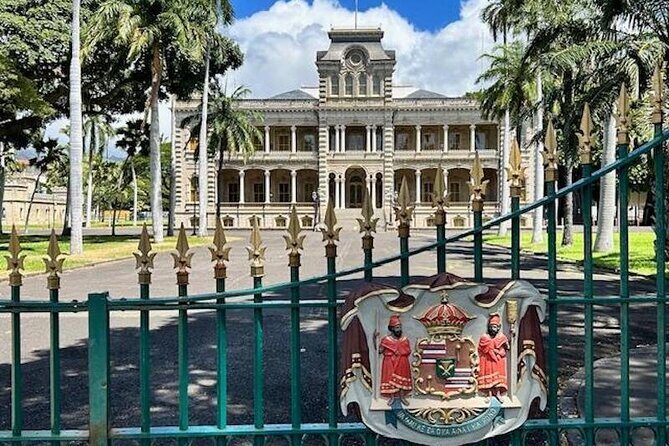
Then you move to Iolani Palace, the royal residence that lands like a plot twist: a palace tied to Hawaiian royalty, sitting inside the United States. The time here is brief (about 10 minutes), and admission isn’t included, so plan accordingly.
What you’re doing at Iolani Palace isn’t just sightseeing. You’re taking a look at a symbol of sovereignty—something the story of the monarchy both depended on and ultimately lost. This stop is where you’ll start feeling the “strange and tragic” part of the tour title, because the building’s purpose is royal, while the final outcome is a political overthrow.
Drawback to keep in mind: since admission isn’t included, some visitors may decide to focus on the outdoor elements while others might pay to see more inside. If interiors matter to you, budget time and money. If you’d rather keep it simple, the guide can still help you understand the significance of what you’re seeing.
Kawaiahaʻo Church and Mission Influence: A Stone Church With a Cost
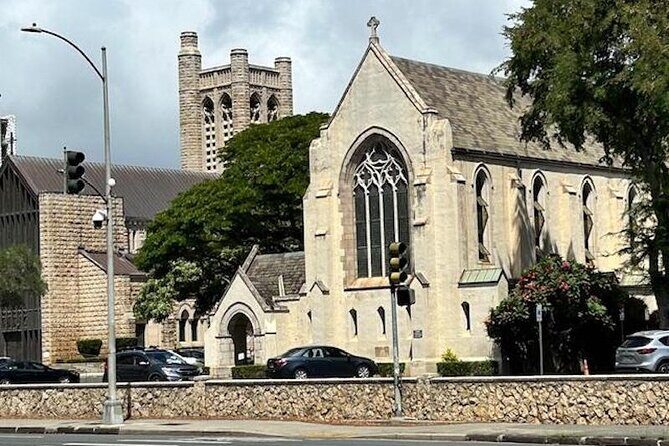
Next up is Kawaiahaʻo Church. It’s often described as a stone church, and that’s part of the point: the message and method of missionary Christianity arrived with architecture you can physically stand near today. The tour credits its design to Hiram Bingham, and the guide uses that to talk about the culture collision—how something framed as religious progress could also feel like control.
This stop is listed as about 10 minutes and admission is free. The length matters because it suggests you won’t get lost here. You’ll get the core story, then move on before it becomes too much.
If you like context, this is a strong moment. Churches on the surface can look like history lessons already written. Here, you’re reminded that institutions have consequences—sometimes intended, sometimes not.
Hawaiian Mission Houses Historic Site: When the Story Turns Moral
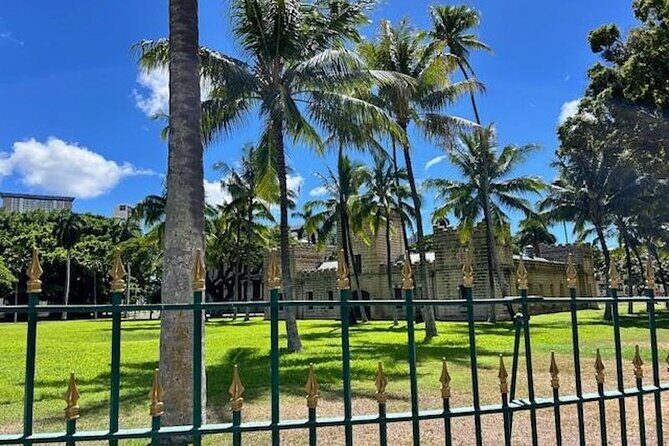
Stop 4 is the Hawaiian Mission Houses Historic Site and Archives. The tone shifts a little. If the church stop feels like impact through religion, the mission houses site feels like impact through organization.
What I like about this stop is that it doesn’t treat missionaries as a single-note villain or hero. It frames the work as both persuasive and deeply consequential. The guide’s approach helps you see how institutions can grow fast when they have money, education, and social influence.
It’s a short stop (about 5 minutes) and admission is free, so you’re not getting a full museum session. But you’re getting the narrative anchor that makes later civic and legal stories land.






Honolulu Hale and the State Capitol: Beautiful Buildings With Uncomfortable Edges
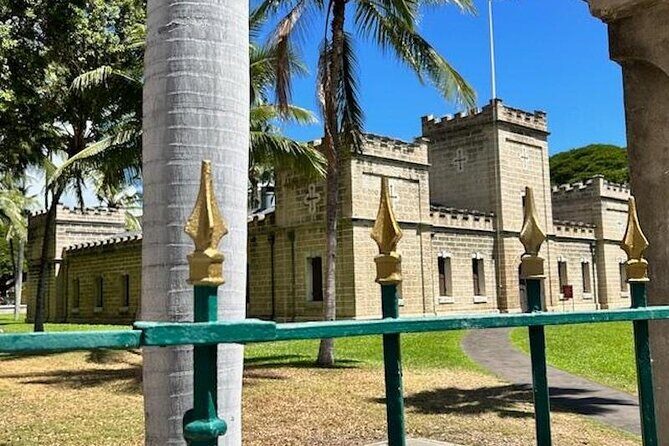
Now you head to Honolulu Hale, the city hall building. The tour calls it an Italianate Spanish Colonial Revival structure, and you’ll likely notice the styling right away. The tricky part is the second layer: it has an unlovely past.
This is another reason the tour works. It trains you to look beyond aesthetics. A pretty facade can hide a political or cultural history you’d never guess just by looking at the stonework.
Then comes the Hawaii State Capitol, described as an elegant expression of aloha spirit—paired with a statue that has a story. This stop pairs symbolism with interpretation. You’re not just being told that a statue exists. You’re being told why that image became a public statement.
Both stops are free and brief (around 5 minutes each). They’re quick hits. If you want long museum time, you won’t get that here. But if you want meaning per minute, this route is built for you.
Washington Place: The Queen’s Home After the Overthrow
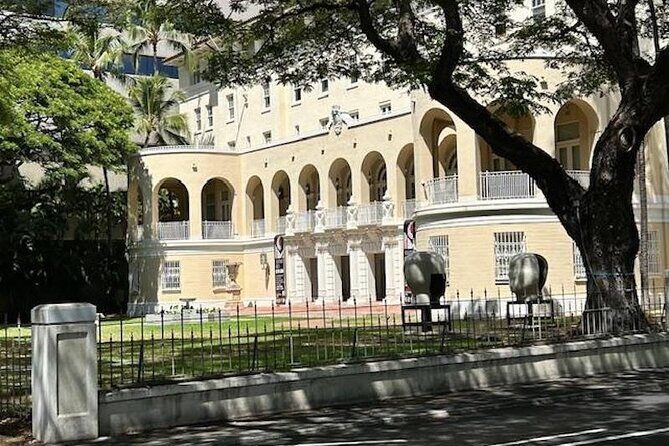
Stop 7 is Washington Place, Queen Liliuokalani’s home. This is one of the tour’s emotional anchors. The route notes she lived there in an unhappy marriage and returned after the overthrow of the monarchy.
That last detail changes the way you see the house. Instead of viewing it as a historic home, you view it as a place carrying loss, displacement, and the afterlife of power. It’s not the loudest stop. It’s the kind that lingers, because the story behind it isn’t about ceremony. It’s about what happened when ceremony ended.
Time is short (about 5 minutes), and admission is free, but you’ll likely spend it absorbing what you’ve learned so far. By now, the tour has already set up the logic: conquest leads to monarchy; monarchy leads to overthrow; overthrow leads to new realities—and these buildings are where those realities are recorded.
Cathedral of St. Andrew: Sandstone, Stained Glass, and Tragedy

At Stop 8, you get the Cathedral of St. Andrew. The tour notes something very specific: it’s built from thousands of blocks of sandstone cut in England and shipped to Hawaii. That detail matters because it’s physical proof of how far religion and materials traveled—religion carried by people, and people backed by resources.
And then you get the emotional punch: a magnificent stained glass nave plus a tragic tale connected to a king and his little boy. The setup here is clever. You first notice craftsmanship. Then you learn the story behind it.
This stop is about 5 minutes and free. You won’t get time to study every window like you would in a longer cathedral visit. But if you’re the type who likes learning what you’re looking at, this is worth it.
You might also notice the tour’s tone includes spooky, ghostly-leaning storytelling. The factual parts stay grounded, but the guide’s style brings an eerie mood to some of the places—enough to feel fun, not enough to replace real history.
Capitol Modern: The Royal Hawaiian Hotel’s Afterlife
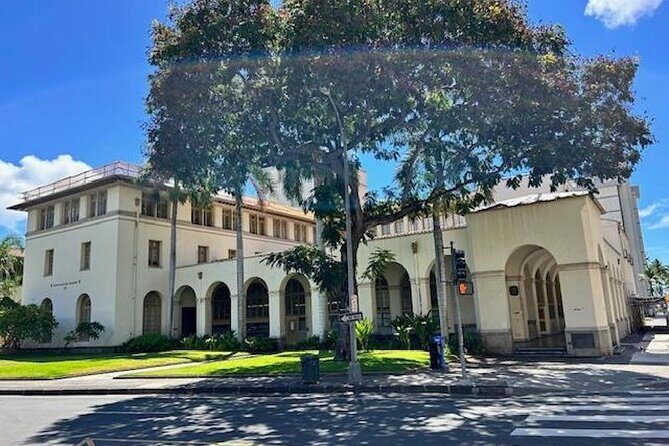
Stop 9 is Capitol Modern, also known as the Hawai‘i State Art Museum. Here’s the key context: this building was the original Royal Hawaiian Hotel, built in 1872. It was so successful that a second Royal Hawaiian Hotel was built on Waikiki Beach, called the Pink Palace.
This is a cool transition because it shows how Hawaii’s leadership and tourist-ready image evolved after major political shifts. The story isn’t just “a building exists.” It’s “an idea of Hawaii got packaged and exported,” for better and worse.
Time is short (about 5 minutes), and admission is not included. If you’re curious about seeing more art inside, budget for that separately. If you’re not, you’ll still come away with the significance of what the building used to be.
Ali‘iolani Hale: Where Law Played Out
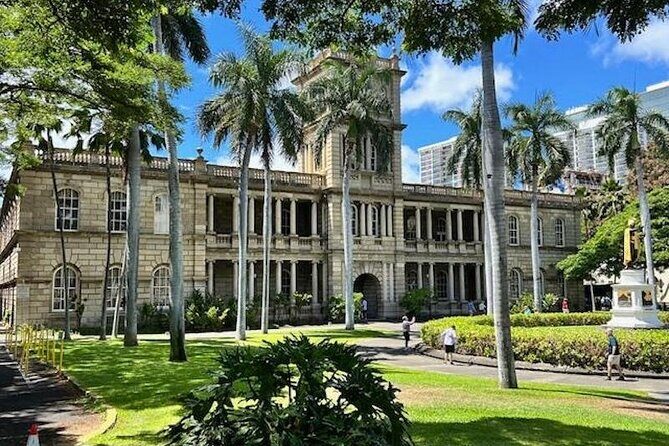
Stop 10 is Ali‘iolani Hale, now the Judiciary Building and home to the Hawaii State Supreme Court. The route highlights something dramatic: the Massie Affair, described as the marquee event of Hawaiian jurisprudence, playing out here.
This is where the tour becomes more than cultural history and turns into governance history. You start seeing how power doesn’t only happen through conquest and monarchy. It happens through courts, decisions, and legal narratives that shape who gets rights and who doesn’t.
It’s about 5 minutes and free, so again, it’s a guided “what this place meant” moment, not a courtroom documentary.
Price and Logistics: Why $39 Feels Fair
Let’s talk money without the marketing fluff. At $39 per person for about 1.5 hours, you’re paying for a guided storyline and a tight downtown walking loop. Many stops are free to view, and the value comes from interpretation—how the guide connects each site to the next chapter.
The “watch-outs” are admissions not included at Iolani Palace and Capitol Modern. If you add those, your total trip cost rises. If you don’t, you’ll still get plenty of value because nearly every other stop is free and the route is designed to be meaningful even with quick visits.
Timing also matters. This tour often books around 29 days in advance on average, so it’s smart to reserve early if your schedule is tight. Also, it runs at 10:45 am. Downtown Honolulu weather can change fast, so bring a light rain layer even if the forecast looks friendly.
Group size max is 20, and the tour is offered in English with a mobile ticket. That combo usually means less waiting and easier pacing. It’s also helpful that assistance is available for those who need help with stairs or inclines, and service animals are allowed.
If you have mobility limits, note that the tour includes standing and walking. Plan for short stops, but not constant sitting. Comfortable shoes aren’t optional here.
Who This Tour Is Best For (and Who Might Want a Different Plan)
This is ideal if you want Hawaii history beyond beaches and stand-up paddle boards. You’ll like it if you care about how power shifts—who holds it, who loses it, and how new systems take over.
It’s also great for families and mixed-age groups, especially because the storytelling style can handle both serious and slightly spooky moments. The structure is easy to follow, and the guide’s attention to shade helps on warmer days.
It may be less ideal if you need lots of time inside museums and buildings. The tour is short, so interiors like Iolani Palace and Capitol Modern are handled as quick stops with separate admission. If you want a long, ticketed museum day, pair this with Bishop Museum or another extended stop later.
Quick Checklist Before You Go
Bring:
- Comfortable walking shoes
- A hat and water
- A light rain layer
Decide in advance:
- Whether you want to pay admission for Iolani Palace
- Whether you want to pay admission for Capitol Modern
Go in with the right mindset:
- Expect history with emotional weight, not a light fluff tour
Should You Book This Tour?
If you want a Honolulu experience that goes past postcard Hawaii, I’d book it. This route gives you a structured way to understand Hawaiian monarchy, missionary influence, and the civic institutions that followed—without turning it into a textbook.
I’d skip it only if you strongly prefer indoor museums, you need frequent seating, or you’re not interested in political and cultural history. Otherwise, this tour is a practical way to build real context fast, and you’ll walk away seeing these landmarks with far more meaning than you started with.
FAQ
How long is the tour?
It lasts about 1 hour 30 minutes.
How much does it cost?
The price is $39.00 per person.
What language is the tour offered in?
The tour is offered in English.
Where does the tour start and end?
It starts at the King Kamehameha I Statue, 447 S King St, Honolulu, HI 96813, USA, and ends back at the meeting point.
Are tickets to all stops included?
No. Iolani Palace admission is not included, and Capitol Modern admission is also not included. Other stops listed on the route have free admission.
Is the tour group size limited?
Yes. The maximum group size is 20 travelers.
Is this tour accessible if I need help with stairs or inclines?
Assistance is available for those who need help with stairs or inclines.
Can I bring a service animal?
Yes. Service animals are allowed.